

The Quatermass Xperiment or: The Creeping Unknown
The Quatermass Xperiment or: The Creeping Unknown
Couldn't load pickup availability
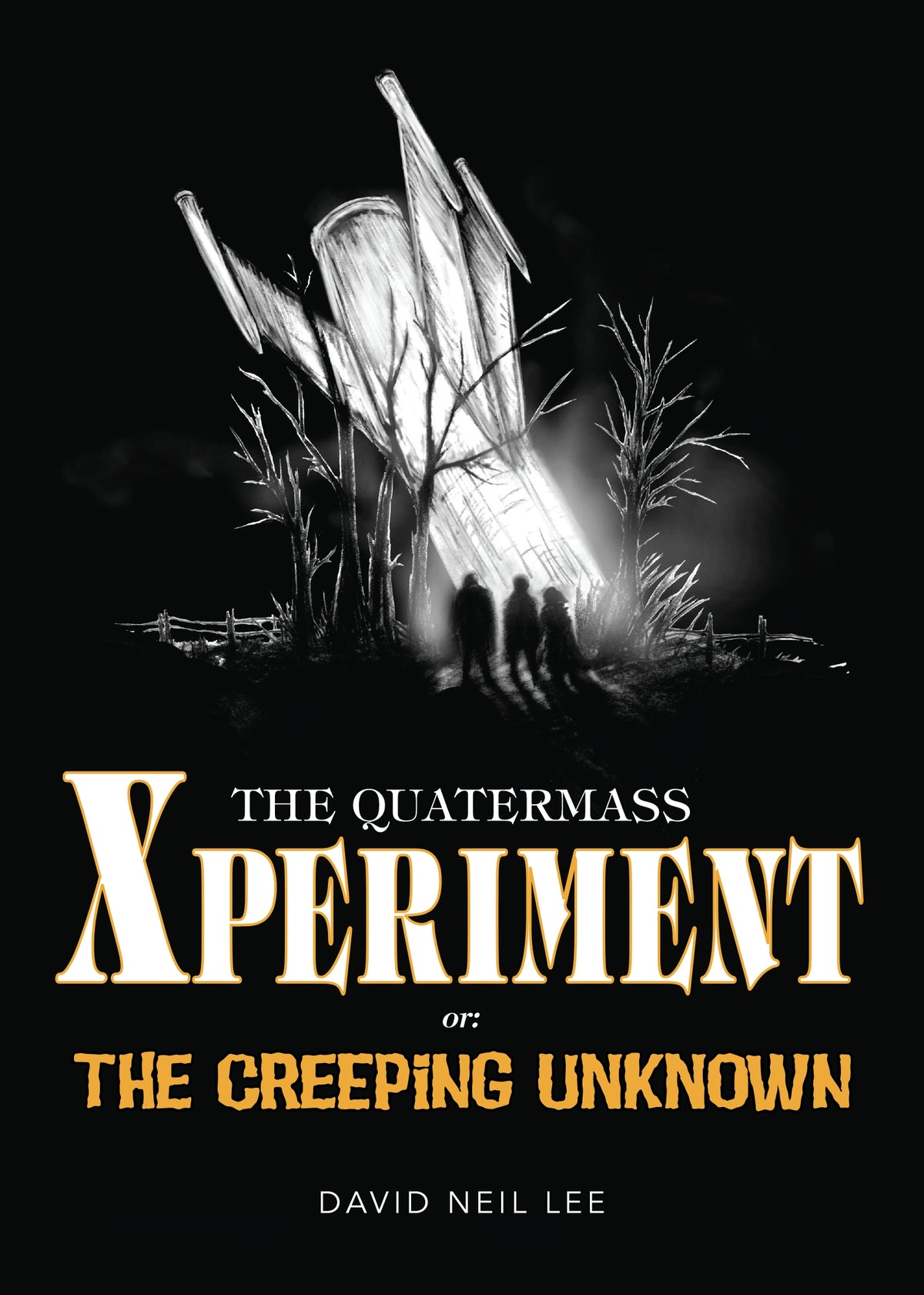
The pioneering sci-fi horror film The Quatermass Xperiment became an international hit for Hammer Films on its release in 1955. Titled The Creeping Unknown in North America, the film influenced a generation of artists ranging from John Carpenter to Stephen King to David Bowie.
Bernard Quatermass, leader of the British Experimental Rocket Group, sends three astronauts into space, but when the rocket returns, only one man is left: Victor Carroon. As Quatermass and his team try to solve the mystery, the tragic Carroon gradually loses his humanity and evolves into a shambling fungal monster who can kill with a single blow.
Author David Neil Lee cites influences on Quatermass creator Nigel Kneale, including Old Testament notions of uncleanness and “creeping things,” the neo-pagan horrors of Victorian mystic Arthur Machen, and the practical limitations of postwar BBC TV technology. Regardless of its title, The Quatermass Xperiment or The Creeping Unknown is an allegory for the death of the British Empire—and of all empires’ inevitable decline.
Ebook formats
Ebook formats
Ebooks are available in EPUB and PDF formats.
Excerpt from The Quatermass Xperiment by David Neil Lee
Introduction: Dreams From Which We Never Awaken
Click here to read a sample of the chapter
Nineteen-fifties science fiction movies, even the best of them, might not be the greatest films ever made, but few of them can be taken lightly. At the very least, most of these films ask weighty questions about power: who doesn’t have it but should, who actually has it, and if you do manage to get some power, what’s to be done with it. The most serious of these films even end with dramatic monologues: from prescriptive (“Keep watching the skies!” The Thing From Another World) to punitive (Klaatu threatens to reduce the world “to a burned-out cinder,” The Day the Earth Stood Still) to profound (“When Man entered the atomic age, he opened a door into a new world,” Them!). By the time they reach the third act, their characters are always playing for the highest stakes: not only their own survival, but the fate of the entire human race.
When these films were first released, they enthralled a young generation of baby boomers, not only with the thrills of monsters, aliens, and high-tech action, but also the drama of their cosmically high stakes. They also inspired a nascent generation of artists who would soon be looking for their own ways into culture.
One of these young fans, Joe Dante, went on to become a notable Hollywood director of horror and science fiction. He has cited the subject of this book—the 1955 Hammer film The Quatermass Xperiment—as an influence and makes it clear that he was attracted to horror and science fiction B movies not only because of the films themselves, but because of their underdog status both within the film industry and society as a whole. For young movie-goers such as Dante, the most vital cinema wasn’t to be seen in first-run blockbusters, or even art house cinemas, but in small-town theatres, suburban drive-ins, downtown grindhouses, and—after they’d made the rounds there—late-night TV. Of a later Quatermass film, Dante points out, “These pictures were not held in particularly high esteem in America, and they were mainly relegated to double bills.”
Their low status was reflected in their modest lengths. Whereas the prestige productions of the early and mid-fifties—Rebel Without a Cause, On the Waterfront, Rear Window—ran around two hours (even longer if we’re talking about Giant or Bridge on the River Kwai), B material such as the Quatermass films had to be no more than ninety minutes long, so they could fit into a double bill with The Bandit Queen, Stagecoach to Fury, or Desire in the Dust.
Even the best of these 1950s science fiction films may have only appealed to a disparate, disconnected fan base among the millions of viewers who saw and forgot them. At the same time, they had enormous exposure, so even the small percentage of those viewers, in the original or succeeding generations, who not only found them striking but considered them important, were enough to have a significant impact. Like jazz records or pulp paperbacks in the same era, these films were made quickly and economically by craftspeople who knew how to balance aesthetics and contingency. And like those books and records, unexpectedly and unintentionally, they eventually became lasting statements of their time and place: iconic works that reward multiple replays and inspire critical analysis on a host of levels and approaches.
The Quatermass Xperiment was Hammer’s first horror film. It starred the American actor Brian Donlevy as Quatermass and was directed by Val Guest from a script based on the BBC TV serial The Quatermass Experiment, by the young British writer Nigel Kneale. The film’s North American title was The Creeping Unknown. It’s a story of the first rocket into space. Three men go into orbit, but only one returns; the other two—Ludwig Reichenheim and Charles Greene—have vanished, and the survivor—Victor Carroon—is undergoing some kind of hideous physiological change. At first a returning hero, Cartoon soon becomes an object of pity, then a hunted fugitive, and finally transforms into a deadly shambling monster that must be incinerated.
Like any good work of horror, The Quatermass Xperiment evokes a feeling, and like any good work of science fiction, it makes a point. Both those things are intimately bound to the era’s zeitgeist—to what the filmmakers knew and felt about their time and place, to their assumptions about how they and their society got there, and to the places that they imagined all this might be taking us. Seventy-plus years later, some parts of The Quatermass Xperiment look as dated as Dickens: the ancient fire engines that race towards the crashed rocket, the Cockney banter between the patient desk sergeant and the tipsy Rosie, even the fusty live broadcast “The Restoration of Westminster Abbey: Your Guide Sir Lionel Dean” that the Carroon-monster crashes.
Also as in Dickens, these details work because they keep the story at ground level, so that it unfolds on a human scale. The original TV serial, soon followed by the film, appeared at the intersection of several significant historical moments—the aftermath of World War II, the British Empire’s forfeiture of colonies as it scaled back to a Commonwealth, the ascension of a popular new monarch, and almost simultaneously another triumphant ascension, the first explorers reaching the top of Mount Everest.
James Chapman writes, “The orthodox interpretation of 1950s sf and horror is to interpret the ‘monster’ as a metaphor for the ‘beast’ unleashed by the atomic bomb, against which there was no conventional defence.” Certainly, the bomb/monster allegory is rampant throughout the monster movies Chapman cites as examples, starting with the US production The Beast from 20,000 Fathoms (1953) and its Japanese reworking, Godzilla (1954). Stephen King and John Carpenter have said the same, and when it comes to monsters, if they don’t know what they’re talking about, who does?
My thesis, however, is that The Quatermass Xperiment gives us quite a different metaphor: the decline—in fact, the disease—of empire. Its story of a brave, optimistic first trip into space can be seen as an allegory for the falsehoods and failures, assumptions and pretensions of the empire itself.
Nigel Kneale admitted that he had little interest in the category “science fiction” to which, after his original serial, he and his work were forever consigned. Indeed, as science fiction, The Quatermass Experiment is in a category of its own. Its overriding message—that the conquests of empire change the conquerors more than the conquered—might have more similarities to Joseph Conrad’s Heart of Darkness or George Orwell’s “Shooting an Elephant” than to any of the science fiction that came before it.
Although Kneale was, of course, familiar with those writers, an even stronger influence might have been turn-of-the-century British authors of “weird fiction,” such as M.R. James and Arthur Machen, who wrote their own allegories of an empire undermined by ancient, supposedly abject forces. The protagonists of their stories have often found success in the status quo and are staunch defenders of it. They discover, however, that modernity is a fragile construct built over suppressed indigenous supernatural worlds (embodied as ghosts or poltergeists, Celtic “little people,” even the pagan Great God Pan himself) that can be all too readily conjured out of hiding.
Quatermass and the British Experimental Rocket Group see space as a frontier ripe for colonization—but it turns out that an invasive horror lurking just beyond Earth’s atmosphere has been eying us, and our planet, just as hungrily. Our confident foray into the great outer dark, the first step of an eventual mass colonizing enterprise, gives this entity a chance to turn the tables: to colonize us.
Considering the amount of time human beings have spent in outer space since 1955, the premise of The Quatermass Xperiment might now seem naive and far-fetched. Firsthand experience has confirmed that the dangers of space are, as predicted, the heat and radiation of the sun and its flip side, the vacuum and absolute zero of the void. We might remember, however, that until the USSR shot Yuri Gagarin into space in April 1961, going 301 kilometres (187 miles) up and making a single orbit of the Earth, no one really knew what would happen up there. In outer-space terms, these pioneer flights were like wading ankle-deep into the shallows, but these were the shallows of an ocean so vast and unexplored that it was only good sense to speculate that dangerous creatures—malign, invisible, incomprehensible, predatory—might be swimming there. After all, forays of conquest had always risked the unexpected: Maps of the charted oceans had dragons and sea serpents drawn into their unexplored margins.

David Neil Lee has written books on jazz musicians Paul Bley and Ornette Coleman as well as the international best-seller Chainsaws: A History. His award-winning “Midnight Games” trilogy of novels pits a teenager in a declining steel town against the malign forces of the Cthulhu Mythos. David has a PhD in English from the University of Guelph. He writes, plays double bass, and lives with his family in Hamilton, Ontario.